
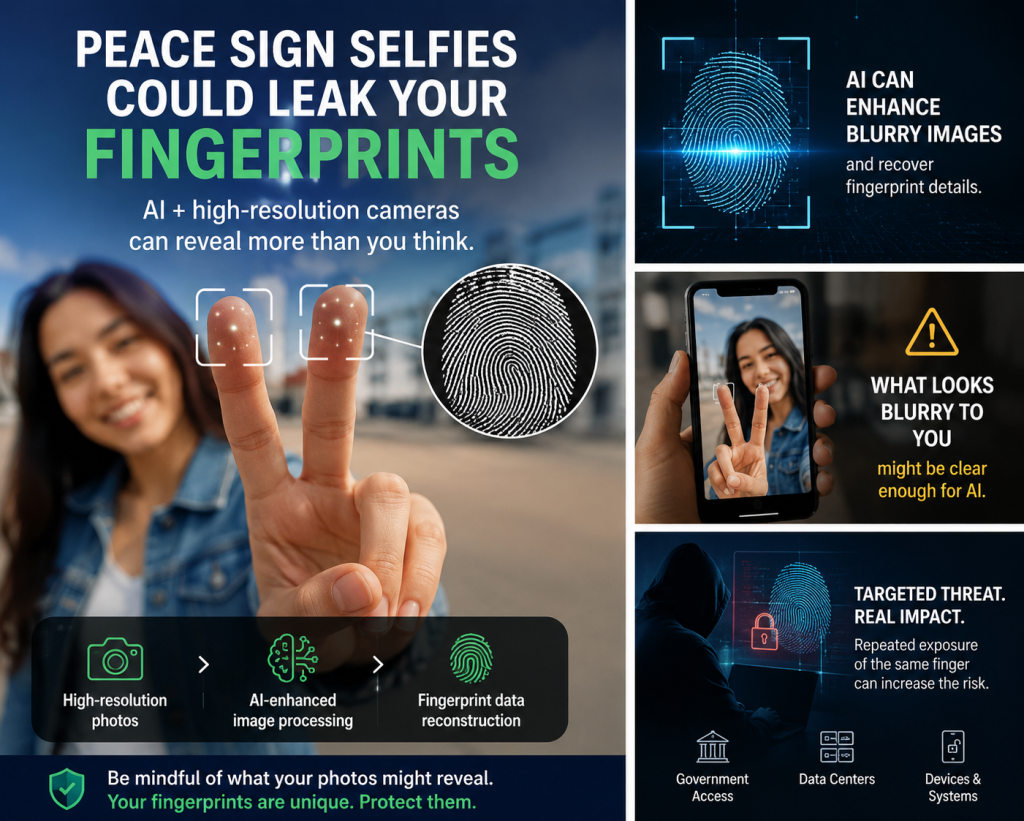
In today’s digital world, taking selfies and sharing photos online has become part of everyday life. But what if a simple peace sign selfie ✌️ could unintentionally expose sensitive biometric information?
Recently, an article published by Cybernews discussed how advancements in artificial intelligence and high-resolution cameras may allow fingerprint details to be reconstructed from photographs.
At first glance, this may sound like something from a science fiction movie. However, cybersecurity researchers and biometric experts have been discussing this possibility for years — and AI is making it more realistic than ever before.
How Can a Selfie Reveal Fingerprints?
Modern smartphone cameras capture an incredible amount of detail. Even when fingerprints appear blurry to the human eye, AI-powered image enhancement tools can sometimes sharpen and reconstruct visible fingerprint patterns.
According to experts mentioned in the article:
- High-resolution images taken at close range may capture enough fingerprint detail for analysis.
- AI software can enhance blurred images to recover clearer patterns.
- Repeated exposure of the same fingers in multiple photos increases the possibility of reconstruction.
This means that a casual peace sign selfie taken close to the camera could potentially reveal more information than intended.
Why This Matters
Fingerprints are one of the most widely used forms of biometric authentication in the world today. They are commonly used for:
- Smartphone unlocking
- Access control systems
- Workplace authentication
- Border security verification
- Secure facility entry
Unlike passwords, fingerprints cannot simply be reset or changed after exposure. If biometric data is compromised, the long-term consequences can be much more serious.
Is This a Real Threat for Everyone?
Cybersecurity experts describe this as a targeted threat rather than an everyday risk for most people.
The average social media user is unlikely to become a victim through ordinary selfies alone. However, high-profile individuals — such as executives, public figures, government officials, or individuals with access to sensitive systems — may face greater risk if attackers intentionally collect detailed public images over time.
The article also references earlier demonstrations where researchers successfully recreated fingerprints from publicly available photographs years before modern AI tools became widespread.
AI Is Changing the Privacy Conversation
One of the most important lessons from this topic is how AI is reshaping cybersecurity and privacy discussions.
Artificial intelligence is now capable of analyzing and reconstructing details from images in ways that were previously difficult or impossible. As technology continues to evolve, even ordinary online habits may carry unexpected privacy implications.
This does not mean people should stop taking selfies or panic about every photo shared online. Instead, it highlights the importance of:
- Digital awareness
- Understanding biometric security
- Practicing responsible online sharing
- Staying informed about emerging cybersecurity risks
Final Thoughts
The idea that a peace sign selfie could expose fingerprint details may sound surprising, but it reflects a larger reality about the modern digital landscape: technology is advancing faster than most people realize.
As AI-powered tools become more sophisticated, cybersecurity is no longer limited to protecting passwords and devices. Protecting personal data now includes understanding how images, biometrics, and online behavior can interact with emerging technologies.
Sometimes, even the smallest online habits can reveal more than we expect.